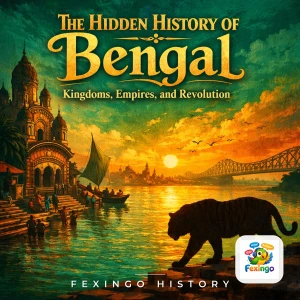
The Hidden History of Bengal: Kingdoms, Empires, and Revolution — Fexingo History
Fexingo 266 episodes 26 Nov 2026
This podcast explores the history of Bengal, from the Gauda and Pala empires and the Bengal Sultanate through the rise of colonial Calcutta and the British East India Company. It follows the Senas, Mughal subahdars, the 1770 famine, the Battle of Plassey, and the cultural flourishing of Bengali literature. Later episodes cover the 1905 partition, the Swadeshi movement, revolutionary nationalism, Subhas Chandra Bose, the 1943 famine, and the 1947 partition. The series connects the 1971 Bangladesh Liberation War to present-day questions of identity, climate change, and economic development.
Episodes

The Battle of Plassey: How One Day Changed India
In this episode, we strip away the myth of Robert Clive’s military genius to examine the political rot that made the Battle of Plassey possible. We explore how Mir Jafar, a commander with deep grievances against Nawab Siraj-ud-Daulah, traded his loyalty for power, enabling the East India Company to seize the Diwani rights. Lucas and Luna dissect the secret treaty signed in April 1757, the role of
The Bengal Sanyasi Rebellion: Holy Warriors
Episode 302 revisits the Sannyasi Rebellion, a lesser-known uprising where ascetic warriors and local rebels clashed with the British East India Company in the late 18th century. While previous episodes touched on figures like Majnu Shah and the Fakir of Satgaon, this episode dives deep into the specific tactics, the role of the Hooghly river, and the complex political landscape of Murshidabad tha
Bengal’s Iron Navy: The Maratha Raids on the Hooghly
While most histories of Bengal focus on the Mughal nawabs or the British East India Company, Episode 301 uncovers a violent, often overlooked chapter: the Maratha raids led by Raghuji Bhonsle in the 1750s. After the collapse of central Mughal authority, the Maratha Empire expanded northward, turning Bengal into a hunting ground for tribute known as chauth and sardeshmukhi. This episode details how
The Matua Movement: Faith, Flight, and Freedom
While the Bengal Renaissance brought art and literature to Calcutta’s elite, a different kind of revolution was brewing in the mud-brick villages of the Hooghly district. This episode explores the Matua movement, founded by Harish Chandra Mukherjee in the late nineteenth century, which transformed marginalized Mahishya farmers into a powerful political force. We trace how this devotional community
The Nawabs of Bengal: Architecture, Trade, and Power
While the British East India Company dominates the narrative of colonial Bengal, the region’s history is deeply rooted in the sophisticated governance of the Nawabs. This episode explores the Nizamat era, focusing on Murshid Quli Khan and Alivardi Khan, who transformed Calcutta into a bustling port while maintaining autonomy from the Mughal center. We examine the architectural legacy of the Tipper
The Sanyasi Rebellion: Holy Warriors Against Empire
We left off with the British East India Company securing Diwani rights after Plassey and Buxar, but power in Bengal wasn't just about tax ledgers. In this episode, we explore the Sannyasi Rebellion of 1763-1772, a fierce, decentralized uprising led by ascetics like Majnu Shah and the Fakir of Satgaon against Warren Hastings's administration. We look at how Tantric rituals and monastic networks pro
The Bhakti Movement: Faith and Freedom in Bengal
In this episode, we explore the profound cultural transformation of medieval Bengal through the lens of the Bhakti movement. We trace the journey from the early devotion of Chaitanya Mahaprabhu to the poetic revolutions of later figures like Ramprasad Sen and Kamalakanta Bhattacharya. You will hear about the radical social implications of ecstatic devotion, how Vaishnavism challenged caste hierarc
The Sufi Poets Who Wrote Bengal's Soul
Long before the Bengal Renaissance brought ink to paper, the soul of Bengal was written in verse by Sufi saints who arrived from Central Asia and Persia. This episode explores how figures like Shah Jalal and Makhdoom Mahisudhi didn't just spread Islam but actively shaped the Bengali language itself. We look at the Chandidas era, where Vaishnava devotion met Sufi mysticism, creating a cultural synt
The Bhil Rebellion: Bengal's Forgotten Tribal Uprising
While historians often focus on the Sanyasi rebels or the Paiks, a different kind of resistance simmered in the dense forests of Midnapore during the early 19th century. This episode explores the Bhil Rebellion of 1832, where tribal communities, led by figures like Tilka Manjhi and later mobilized against the Permanent Settlement, fought to protect their ancestral lands from encroaching zamindars
The Dutch Factory at Hooghly: Bengal's Forgotten Colonial Rival
While British historians often focus on the East India Company, a powerful European rival operated quietly along Bengal’s Hooghly River for nearly two centuries. This episode explores the Vereenigde Oostindische Compagnie and their factory at Chinsurah, established in the mid-seventeenth century under the protection of the Mughal Empire. We examine how Dutch merchants navigated the complex politic
The Sanyasi Rebellion: Holy Warriors of Bengal
In this episode, we look past the standard narrative of British consolidation to examine the Sannyasi Rebellion of the late 1770s. We explore how ascetic warriors, led by figures like Majnu Shah and the Fakir of Satgaon, turned their spiritual authority into a formidable military threat against the East India Company. The story follows these holy men as they raided Company treasuries, disrupted su
Bengal's Mughal Masters: The Art of Administration
While earlier episodes have explored the ancient kingdoms of Vanga, the chaotic Nizamat era, and the brutal conquests of the British East India Company, this episode shifts focus to the administrative heart of Bengal during its golden age under the Mughal Empire. We examine how the Subahdars transformed Bengal into the empire’s wealthiest province, driving global textile trade through hubs like Dh