
First Principles is a weekly interview podcast featuring authentic, candid, and insightful conversations between some of India’s most accomplished founders and business leaders, and Rohin Dharmakumar, The Ken’s CEO & co-founder. Each episode delves into personal philosophies, mental models, decision-making frameworks, reading habits, parenting styles, and personal interests that make each leader unique.
Episodes
CMS Info Systems' Rajiv Kaul on putting his own money into a company he didn't found, walking away from almost every deal, and why mindfulness saved CMS (Part 2)
1 · SummaryPart 1 ended with Rajiv Kaul leaving Microsoft and private equity, partnering Blackstone to buy CMS Info Systems, and deciding he didn't want to work for anyone again. Part 2 is about how a CEO who expected to stay five years ended up its largest individual shareholder. Kaul tells Rohin Dharmakumar how Baring, CMS's second private equity owner, wanted to sell after demonetisati
Rajiv Kaul of CMS Info Systems on why cash isn't dying, his 2x2 for handling a crisis, killing two Nestlé products as an intern, and imposter syndrome at Microsoft (Part 1)
1 · SummaryRajiv Kaul runs the company that fills about one in every two ATMs outside India's bank branches, and he says the business was never really about logistics. In Part 1 of 2, he walks Rohin Dharmakumar through a CMS cash van's day, explains why he thinks cash and UPI are growing side by side, and recalls the night demonetisation was announced, which he spent in a hospital where h
Season 3
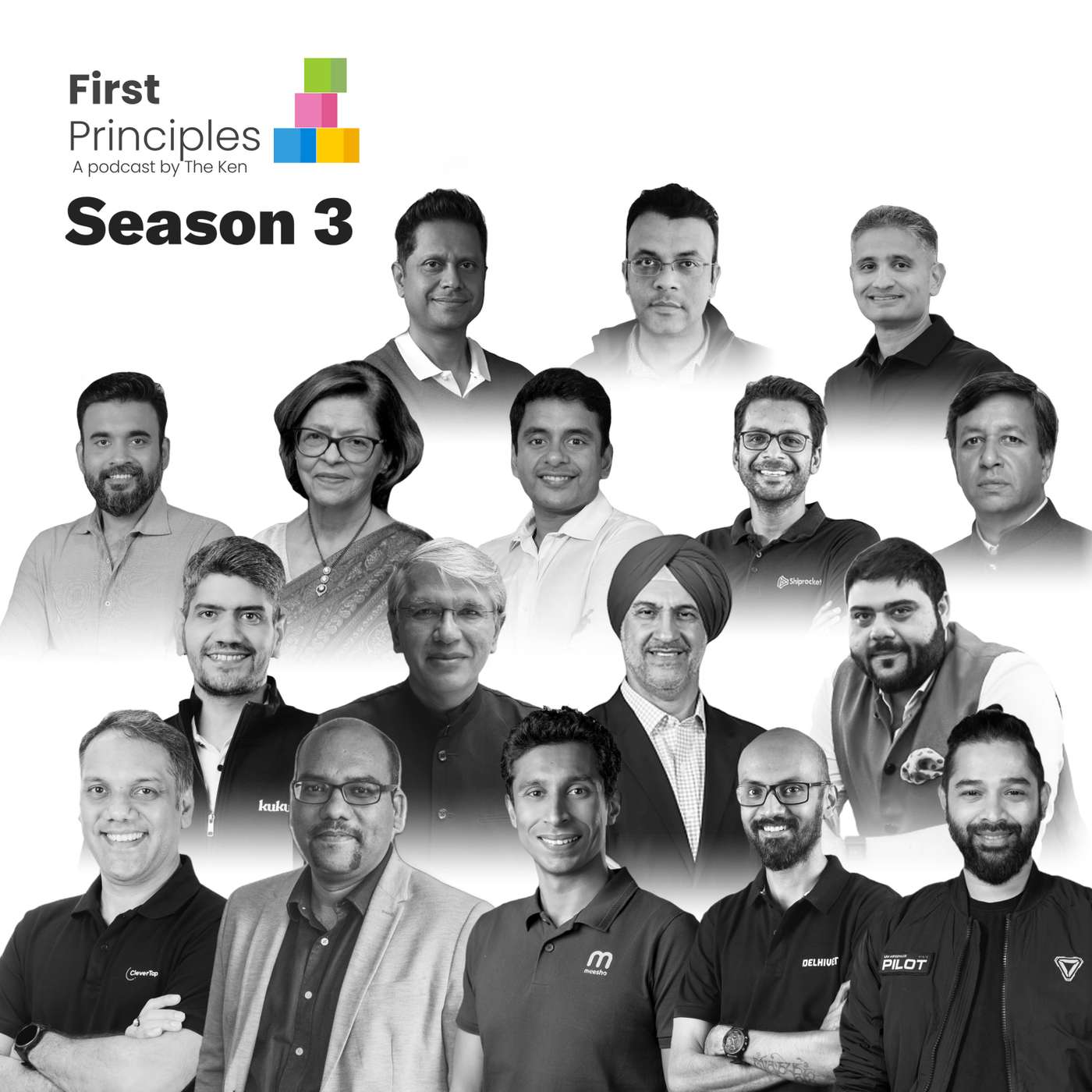
SummaryI have hosted First Principles for four years and 58 episodes, and I have never once stopped to look at it. This episode is me doing that. There is no guest. It runs about fourteen minutes, and it ends with something I need from you.Season 3 started with Vidit Aatrey of Meesho in April 2025 and ended with Mukesh Bansal in August 2026. A lawyer, a banker, a restaurateur and a ventur
Part 2: Mukesh Bansal on hiring for loyalty to a mission, "no means not now", writing three books, and compounding sideways
Where Part 1 followed the companies, Part 2 is about the person behind them. Picking up from Mukesh Bansal's move from one venture to the next, this half gets into how he finds talent ("work with them for six months"), the mental models he runs his life by, and the beliefs underneath them. He explains why rationally no one should start a company, how he processes every rejection as "no me
Part 1: Mukesh Bansal on founder mode in the AI age, the three kinds of professionals in the AI age, and the Haridwar boy who found entrepreneurship in a library
Mukesh Bansal has founded and left more companies than most people build in a lifetime, and in Part 1 he explains why. He founded Myntra and sold it to Flipkart; he co-founded Cult.fit and turned fitness into a category; and today he runs the AI company Nurix and the Meraki Labs studio. Asked what he is now, he says "a learner", and admits he gets bored the moment a company starts working
Fireside Ventures' Kanwaljit Singh on the decade at Hindustan Lever that gave him consumer, raising half the fund he could have, and keeping a coach in his sixties
1 · SummaryPart 2 of 2. Part 1 laid out the bet: a fund built only for Indian consumer brands, back when the idea sounded absurd, and the anti-power-law machine Kanwal Singh built to make it work. This half is the person. The near-decade at Hindustan Lever that gave him his love of consumer, the Intel years, and the Paper Boat conviction that taught him to back the founder over the idea.
Fireside Ventures' Kanwal Singh on the consumer-brands bet nobody believed in, why "for a 5x, nobody will call you legendary," and on refusing the one-100x-outlier game
1 · SummaryPart 1 of 2. Kanwal Singh is the first venture capitalist to appear on First Principles, and the reason is the bet he made with the fund itself. In 2017, at the peak of the tech boom, he walked away from tech investing to raise a fund only for Indian consumer brands, when almost nobody believed India had a consumer story worth venture capital. His first backers weren't institut
Part 2: Saahil Goel of Shiprocket on wanting a paisa of every Indian transaction outside the marketplaces, who doesn't survive at Shiprocket, and still playing Pink Floyd on a Fender
Part 2 of 2. In Part 1 we walked the road from 2011 — three companies, an investor ultimatum, and the capital it took to build. Part 2 is the mind. Saahil Goel starts with what, given hindsight, he'd do differently, then the first principles he runs Shiprocket on (distribution beats product), the two or three metrics he genuinely obsesses over, his bet on applied AI, why he believes you c
Part 1: Saahil Goel of Shiprocket on rebuilding the same company three times, the $4 million he was told to take or leave and why in India you sell outcomes, not software
Part 1 of 2. Most people date Shiprocket to 2017; in truth it was born in 2011, and the road there runs through two companies called KartRocket and Craftly. Saahil Goel walks Rohin through the build: Rs 15 lakh of their own money, nearly not being hired by their own first engineers, the hard lesson that in India you sell outcomes not software, an investor ultimatum to take $4 million or n
Part 2: Impresario's Riyaaz Amlani on digital landlords, doers & divas, and why delivery will never eat dine-in
Part 2 moves from the journey to the operating philosophy. Riyaaz Amlani unpacks his evolving stance on the aggregators — from resistance to "uneasy truce" — and the hard lesson that restaurateurs who send guests to Zomato and Swiggy have only themselves to blame. He argues delivery and dine-in are two different businesses, lays out his ambition to turn Impresario into a full-service-rest
Part 1: Impresario's Riyaaz Amlani on Mocha, "Handmade," four near-deaths and 25 years of building places to be
Part 1 of Rohin Dharmakumar's conversation with Riyaaz Amlani is the origin story: why a returning UCLA grad decided Bombay was missing "places to be," how Mocha became Social, and what it actually takes to keep a restaurant group alive for 25 years in the highest-mortality business there is. The shisha ban, the private-equity money that never arrived, COVID, the marble hustle at age six,
Part 2: Kuku’s Lal Chand Bisu on the Bathoth-to-Bandra arc, learning from iterations not books, and why nos beat yeses
Part 2 picks up exactly where I left Bisu — on why a 7-year-old audio platform is releasing a theatrical film on May 8. From there, we go everywhere. Bisu's actual journey from a small village in Shekhawati to Bandra. The "full equation" view of metrics. Why saying no requires more work than saying yes. Why most of his learning comes from iterations, not books. And, in his closing answer,
Recommended

How I Masaba

The Daily Brief Hindi
Ente Ormmakkay | 40 Days Eucharistic Deliverance Prayer | Fr Daniel Poovannathil | Shalom Podcast

The CHRO Mindset

The Achiever's Talk
Capitalmind with Deepak & Shray

FinCrime Jobs : AML, KYC & Compliance Insights

Side Notes by Zerodha Varsity

Moneycontrol Podcast
MSME TALK

9Natree Hindi

कृषि की धड़कन - The Agri Pulse